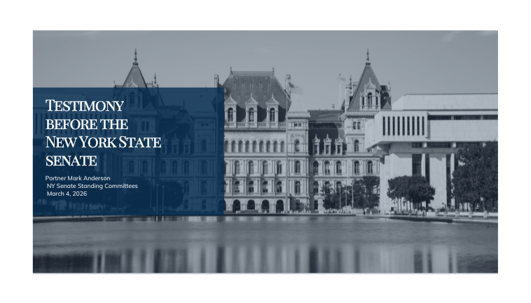
On March 4, 2026, Anderson Bowman PLLC founding partner Mark Anderson testified before the New York State Senate Standing Committees on Codes and Consumer Protection at a public hearing examining fraud affecting consumers, workers, and businesses across the state.
The hearing focused on emerging fraud patterns in areas including foreclosure practices, mortgage servicing, wage theft, and digital financial markets.
During his testimony in Albany, Anderson addressed what he described as a systemic scheme in foreclosure litigation that has inflated foreclosure judgments and deprived homeowners of equity owed to them after foreclosure sales.
Inflated Foreclosure Judgments
Anderson explained to the Committees that New York law sets clear rules for calculating interest in foreclosure cases.
Under the Civil Practice Law and Rules (“CPLR”) and guidance from the New York Office of Court Administration, interest accrues at the contractual rate until a judgment of foreclosure and sale is entered, and thereafter at the statutory rate.
Despite these directives, Anderson testified that some foreclosure law firms have routinely used impermissible calculation methods, including compounding interest or calculating interest on inflated “judgment amounts.”
According to Anderson, these practices can artificially inflate foreclosure judgments and have two major consequences:
- Reducing or eliminating surplus proceeds that would otherwise belong to homeowners after a foreclosure sale.
- Generating inflated reimbursement claims submitted to federal housing programs such as HUD/FHA and government-sponsored entities, including Fannie Mae and Freddie Mac.
The Impact on Homeowners
The financial impact described in the testimony is significant.
A Freedom of Information Act request to the New York City Department of Finance revealed approximately $150 million in unclaimed foreclosure surplus funds in New York City alone.
Independent reporting has also pointed to the widespread nature of the issue. In December 2025, investigative journalists at the Gothamist and New York Focus analyzed roughly 10,000 foreclosure records statewide and identified at least 7,400 foreclosure cases since 2013 involving law firms that routinely used disputed interest calculation methods.
“When patterns like this appear across thousands of foreclosure cases, it raises serious concerns about systemic practices that deserve careful scrutiny.” — Mark S. Anderson
In some cases, inflated foreclosure judgments may also raise the minimum auction bid high enough to deter outside bidders, allowing lenders to acquire properties for nominal amounts before reselling them later for substantially higher prices.
Litigation Already Underway
Anderson’s testimony also highlighted ongoing federal litigation addressing these issues.
Anderson Bowman PLLC and co-counsel have filed multiple class-action lawsuits in the Eastern District of New York on behalf of homeowners, challenging foreclosure judgment practices and alleging violations of federal and state consumer protection laws.
These cases seek to recover damages and address what plaintiffs allege is systemic misconduct in the foreclosure process.
Legislative Attention and Potential Reform
The issues raised in the testimony have already drawn legislative attention.
Following investigative reporting on foreclosure calculation practices, State Senator Zellnor Myrie introduced legislation to standardize referee reporting forms statewide and to prohibit compound interest during the pre-judgment foreclosure period.
In his testimony, Anderson urged lawmakers to consider additional reforms, including:
- Mandatory judicial review of foreclosure interest calculations
- Enhanced civil and criminal penalties for fraudulent foreclosure practices
- Improved notice and recovery procedures for surplus proceeds owed to homeowners
- Greater accountability for attorneys and law firms engaging in systemic noncompliance
- Strengthening the State False Claims Act to address fraudulent foreclosure reimbursement claims
Protecting Property Rights and Process Integrity
Anderson emphasized that the foreclosure issues discussed in Albany are not historical problems but ongoing practices affecting homeowners across New York today.
For many families who lose their homes through foreclosure, surplus equity is the last remaining financial resource after the loss.
Ensuring that foreclosure judgments are calculated accurately and lawfully, Anderson told lawmakers, is essential to protecting those rights.
Attorney Advertising: This post is for informational purposes only and does not constitute legal advice. Prior results do not guarantee a similar outcome.
On March 4, 2026, Anderson Bowman PLLC founding partner Mark Anderson testified before the New York State Senate Standing Committees on Codes and Consumer Protection at a public hearing examining fraud affecting consumers, workers, and businesses across the state.
The hearing focused on emerging fraud patterns in areas including foreclosure practices, mortgage servicing, wage theft, and digital financial markets.
During his testimony in Albany, Anderson addressed what he described as a systemic scheme in foreclosure litigation that has inflated foreclosure judgments and deprived homeowners of equity owed to them after foreclosure sales.
Inflated Foreclosure Judgments
Anderson explained to the Committees that New York law sets clear rules for calculating interest in foreclosure cases.
Under the Civil Practice Law and Rules (“CPLR”) and guidance from the New York Office of Court Administration, interest accrues at the contractual rate until a judgment of foreclosure and sale is entered, and thereafter at the statutory rate.
Despite these directives, Anderson testified that some foreclosure law firms have routinely used impermissible calculation methods, including compounding interest or calculating interest on inflated “judgment amounts.”
According to Anderson, these practices can artificially inflate foreclosure judgments and have two major consequences:
- Reducing or eliminating surplus proceeds that would otherwise belong to homeowners after a foreclosure sale.
- Generating inflated reimbursement claims submitted to federal housing programs such as HUD/FHA and government-sponsored entities, including Fannie Mae and Freddie Mac.
The Impact on Homeowners
The financial impact described in the testimony is significant.
A Freedom of Information Act request to the New York City Department of Finance revealed approximately $150 million in unclaimed foreclosure surplus funds in New York City alone.
Independent reporting has also pointed to the widespread nature of the issue. In December 2025, investigative journalists at the Gothamist and New York Focus analyzed roughly 10,000 foreclosure records statewide and identified at least 7,400 foreclosure cases since 2013 involving law firms that routinely used disputed interest calculation methods.
“When patterns like this appear across thousands of foreclosure cases, it raises serious concerns about systemic practices that deserve careful scrutiny.” — Mark S. Anderson
In some cases, inflated foreclosure judgments may also raise the minimum auction bid high enough to deter outside bidders, allowing lenders to acquire properties for nominal amounts before reselling them later for substantially higher prices.
Litigation Already Underway
Anderson’s testimony also highlighted ongoing federal litigation addressing these issues.
Anderson Bowman PLLC and co-counsel have filed multiple class-action lawsuits in the Eastern District of New York on behalf of homeowners, challenging foreclosure judgment practices and alleging violations of federal and state consumer protection laws.
These cases seek to recover damages and address what plaintiffs allege is systemic misconduct in the foreclosure process.
Legislative Attention and Potential Reform
The issues raised in the testimony have already drawn legislative attention.
Following investigative reporting on foreclosure calculation practices, State Senator Zellnor Myrie introduced legislation to standardize referee reporting forms statewide and to prohibit compound interest during the pre-judgment foreclosure period.
In his testimony, Anderson urged lawmakers to consider additional reforms, including:
- Mandatory judicial review of foreclosure interest calculations
- Enhanced civil and criminal penalties for fraudulent foreclosure practices
- Improved notice and recovery procedures for surplus proceeds owed to homeowners
- Greater accountability for attorneys and law firms engaging in systemic noncompliance
- Strengthening the State False Claims Act to address fraudulent foreclosure reimbursement claims
Protecting Property Rights and Process Integrity
Anderson emphasized that the foreclosure issues discussed in Albany are not historical problems but ongoing practices affecting homeowners across New York today.
For many families who lose their homes through foreclosure, surplus equity is the last remaining financial resource after the loss.
Ensuring that foreclosure judgments are calculated accurately and lawfully, Anderson told lawmakers, is essential to protecting those rights.
Watch Mark Anderson's testimony beofre the New York State Senate
Attorney Advertising: This post is for informational purposes only and does not constitute legal advice. Prior results do not guarantee a similar outcome.